Showing posts with label Science. Show all posts

Friday, November 24, 2017

Teach risk taking and resilience to the next generation: "The Girl Who Thought in Pictures", a review


My heart pounded as I waited. I was estatic to start school! Finally, the big yellow bus headed down my street!

 I sprinted for the house. 


Wednesday, March 8, 2017

Water play STEM activity to go with your toddler's favorite song


This toddler water table activity based on the Itsy Bitsy Spider song is a fun STEM activity to go with one of your child's favorite books.


My daughters have done this twice and loved it both times.

Thursday, December 8, 2016

50 Fun Kids Science Activities

Kids love science activities from chemistry experiments to ecology projects, physics and chemistry. 


My kids love doing these science activities includes some units and NGSS alignment as well as projects appropriate for home.


The brakes of the school bus squeal to a halt on a sunny but crisp Friday afternoon. Two sets of sneakers pound up the drive way. One breathless child exclaims, "Mom! Guess what we did today?" There was no doubt in my mind how his teacher had chosen to spend that afternoon.

I knew how he had chosen to play as a toddler: stacking blocks to watch the tower tumble, splashing fearlessly into the water to examine the hidden treasures of the lake.  If you've ever wondered why your child makes so many messes, you know what I mean. His eyes were always full of wonder. I had seen that same wonder in the eyes of scientists and professors I met at university. They called their million dollar tools "toys" and forgot to go home for dinner for sheer excitement.

Your kids will be running to tell you what they've learned with these science activities.
It was the weekend, but he was determined to repeat the project they had done at school.


Saturday, September 3, 2016

20+ Captivating Preschool Science Activities

Preschool Science Activities

Tiny fingers grasp a piece of cereal, deliberately holding it over the floor below. The fingers part. The cereal falls. The scientist resets for another trial. You have probably seen your toddler perform this experiment. Preschoolers love doing science! I am excited share some of my preschoolers' favorite science activities.

Friday, July 22, 2016

How to get a box of amazing hands-on science projects sent your door

"You haven't given your kids a chance to be bored!" My mom's assessment of our summer schedule reflects my own feelings, but I don't think my children would agree. No one wants the school schedule back, but they could handle a little excitement, and even some learning. The summer chaos has already doubled my work load in the kitchen and the laundry room. Planning great activities is tough. Can you relate? If so, I have the perfect solution for you today.


Do you ever wish someone would just put together four or five science projects, and box up everything you need and send it to your house?


Tuesday, March 8, 2016

Why is there More Wind in the Spring and Fall? and 10 Amazing Do ItYourself Wind Chimes

Why is there more wind in the spring  and fall than at other times of year? And, 10 cool wind chimes you can make to take advantage of that wind.


The neighborhood sirens scream. I grab the baby and call my kids into the hallway, checking my phone to figure out just how far away the tornado is. Tornados come when winds pick up in the spring and fall. The wind can be scary, but most days we enjoy the breeze. It's a great time to build a wind chime, and I have ten amazing wind chime ideas for you. Why is it extra windy during spring and autumn?

What's so special about spring and autumn?


To understand why the winds pick up in spring and fall, think about what else is happening. In the spring, the suns rays are becoming more direct, and beginning with the Equinox, are hitting the earth for more of the day than not.

The result of this direct radiation from the sun is that the air near the surface begins to warm. You may have heard the phrase "heat rises." That isn't true, but warm air rises.

As the air particles heat up, they expand to a greater volume for the same mass. This is called lower density. You could say that the warm air weighs less. It begins to float for the same reason boats float. As the warm air rises, cool air flows in to replace it, and the result is known as wind.


In the fall, the whole system works in reverse, with warm air being forced out of the way. 

Exactly how the wind will blow can't be exactly predicted. They follow a pattern best described by Chaos Theory.

Why is there more wind in the spring  and fall than at other times of year? And, 10 cool wind chimes you can make to take advantage of that wind.


I have some amazing Do IT Yourself wind chimes to help you take advantage of the breezes.


Do it Yourself Windchimes


Why is there more wind in the spring  and fall than at other times of year? And, 10 cool wind chimes you can make to take advantage of that wind.

Clock wise 
Clothespin Windchimes from B-Inspired Mama
Pony Bead Windchimes from Where Imagination Grows
Key Wndchimes from Inner Child Fun
Nature Windchimes from Hands on as We Grow

More great wind chimes  Rainbow Windchimes from sticks from Happy Hooligans
Coffee can Windchimes also from Happy Hooligans
Cutlery Windchimes from Red Ted Art
Bamboo Windchimes from Michelle Made Me
Recycled Windchimes from Maker Mama Craft Blog (This one is really simple!)
Out door Music Windchimes from Hands on as We Grow

Wishing you a gentle change of seasons, with no tornadoes and winds just right for a lovely wind chime.


You may also be interested in

A Simple Introduction to Chaos Theory

A Weather Demo you can do while making dinner
Easy Windsock to make with Kids
Why boats float + 10 boats to make

Thursday, January 14, 2016

Lovely Valentine Experiment for Kindergarten

This is simple science experiment that will dress up your Valentine cards.

Here's some lovely process art for you to try. Perfect for making those kindergarten Valentines even prettier!

My kindergartner and I had the best time experimenting with these home made Valentines. We made some beautiful designs, and got just a little messy. This would be a great way to spend time with your favorite kids.


How to do a Lego Engineering Project for Second Grade


Here's a beginner Lego engineering project that's fun enough to do at home, and aligned to NGSS standards for school.


"That's so cool. I have to tell Mom!" Over hearing that phrase makes any winter break project a winner on its own, but this LEGO engineering project was also super easy and covers NGSS standard k-2ETS1-2

"Develop a simple sketch, drawing, or physical model to illustrate how the shape of an objec helps it function as needed to solve a given problem."

Friday, January 8, 2016

How to Pick the Best Science Fair Topic for Winning OR Taking it Easy

Do you need a topic for science fair? Here's how to come up  an easy topic or a winning topic.


When he was in middle school, my husband went to the county level for his science fair project. I am sure it was not because he and his partner did a meticulous job on their research. It might have had something to do with their topic selection.

If you would like to win, or if you would just like your child to get their science fair project done the easiest possible way, you need to choose the right topic.  You could  start by searching on-line for a science fair topic. You'll find long lists of "winning science fair projects". Can I tell you a secret? You aren't very likely to win with those. Many of them involve obscure science.  Worse, they involve random items, and may not even work: not exactly easy. I have a better method for you.


Friday, June 12, 2015

Thirteen fun ways to observe the science of sound

Observation is the very first science skill your child needs to learn.  If you teach your child to observe sounds carefully, you will set them up to enjoy music and appreciate the beauty of the patterns found through out nature.  The mathematical precision that dictates how sounds are formed is a phenomena that has engaged some of the world's most brilliant minds, and it is sure to enthrall your learners as well!

The best way to learn science is by playing with a concept.  Here are some really fun ways to learn about how sound works.


Here are some fun activities you can use to engage the brilliant young minds in your home.


Activities for exploring timbre or the "color of sound"


Make some sound shakers like these from MamaPapaBuba, or these from the preschool Tool Box.


Make a sound matching activity and talk about pitches.  Royal Baloo has a great example of a sound match.  Kid's Activity Blog has another great sound match.

Make a musical tree, from Adventures of Adam.


Try some virtual sound experiments check out this post from IGame Mom.


Activities for observing pitch


Use Bubble wrap to learn about pitch


Learn intervals and pitches with these ideas from Let's Play Kids Music.  Did you know those are really based on math?

Do this great investigation from Frogs Snails and Puppy Dog Taiks on how size of sticks affects the sound they produce.


Use bubble wrap to explore pitch.


Activities for exploring the sounds of Nature


Print this sound based scavenger hunt from Inspiration Laboratories.

Imitate the sound of rain by making their own rainsticks like Not Just Cute.


Check out this post from i-game mom to learn more about sounds found in nature.


Experiments about how sound travels


Use your silver wear to make an instrument like KCEdventures.

Make a Kazoo like Buddy and Buggy.

Experiment with which objects make loud noises and which don't, from Best Toys 4 Toddlers.


Ok, now it's time to pick at least one of these activities and give it a try!


You might also be interested in   


Monday, May 4, 2015

3 Steps to a Kid Friendly Garden


I love gardening! My family always grew large gardens when I was a child. Now that I have my own kids, we garden together. One year it was basil on our seventh floor balcony, another year it was squash in flower beds at the duplex we rented.  Every year my children look forward to being involved and learn something new.

This year I was envisioning a huge, organic plot, like the one my grandpap used to grow. Then life with kids happened, and it was time to plant here in the Southeast, and I did not even have seeds! If you had wanted to do a garden for your kids this year, but it's already planting time (or a little past!) where you are, don't give up! There is still time to harvest the benefits of gardening with your children.  Just follow these three easy steps.


Did gardening season catch you by surprise?  Don't give up on planting a garden to enjoy with your children!

What is a kid friendly garden?

A kid friendly garden is a space with growing plants where children are welcome.  It can have special features, or it can just have plants.  Children are naturally drawn to growing things, as long as we make the space safe and allow them to participate, the garden is naturally kid friendly.

Step one to a kid friendly garden: go shopping

Now, if you are a seasoned gardener, or have plenty of time, it is better to make some plans. If that is you, check out what Evelyne at Nemsock farms has to say.  However, if you are like me this year, and just want a great learning experience, grab the kids and head to the local hardware store.

Did gardening season catch you by surprise?  Don't give up on planting a garden to enjoy with your children!

Shopping list if you have dirt to plant in


Seeds, 1 packet per 3 square feet or 1 square meter you intend to plant

Shovel, if you don't have one already

Soil test kit, optional


Shopping list of you do not have dirt


Seeds

Dirt

Pots

Step two to a kid friendly garden:  Plant the seeds


Follow the dates on the back of the seed packet the best that you can, but remember this is about the experience.  Better to plant and fail than to not plant.  If you are looking for more detail, check out what Nelle at Rhythms of Play has to say about working with each plant with her kids.

Did gardening season catch you by surprise?  Don't give up on planting a garden to enjoy with your children!


You may need to spend some time preparing the soil before the seeds can go in.  Seasoned gardeners will spend significant time preparing the soil.  In our case, my husband borrowed a rototiller from some generous neighbors and we put the seeds in.  We did test the soil, record the results, and add some fertilizer.  I plan to improve as we go.  A kid friendly garden is all about learning.

Did gardening season catch you by surprise?  Don't give up on planting a garden to enjoy with your children!

Step three to a kid friendly garden: Watch.  


The point of a kid friendly garden is to explore how to grow plants.  In my case, I am new to gardening in this area, so it is  a learning experience for me too.  I started keeping a journal last summer to help is track how our plants are growing.

One of the main lessons we learned last summer was to protect the young plants from chipmunks until they were big enough that they wouldn't be eaten whole. This summer, we are adding to our knowledge. 


See how easy gardening with kids can be?   Now, grab your kids and head to the store!


Be the first to know about new curriculum from Thriving STEM and receive an organized list of new and seasonal ideas for enjoying science and math with your children by signing up for the Thriving STEM newsletter.


You may also like:


Friday, April 24, 2015

Kid made nesting supply station

Caring for the wild creatures in our own neighborhood is my favorite way to teach my children to respect the environment.  The Pony Artist wanted to welcome the Robins.  I did a little research, and discovered that birds may appreciate nesting supplies.   Here's how she made her own nesting supply station.

Welcome the birds back to your neighborhood with this easy project!


If you would like to make a nesting supply station, here's what you need:


Two strips of felt
Thread
Needle scissors
Yarn (Be sure to use cotton, not synthentic, for the safety of the birds.)


First, the Pony Artist chose two strips of felt from our left over stash.

Welcome the birds back to your neighborhood with this easy project!


Next, she sewed the ends together.  This was the most challenging part.


Now it was time to prepare the actual supplies.  She chose some yarn and some string she thought the birds would like and snipped it into pieces.

Welcome the birds back to your neighborhood with this easy project!


She put it in the holder, and we tied it to a tree branch.  

Welcome the birds back to your neighborhood with this easy project!

It was emptied quickly and my husband thought it looked like the birds were trying to take the holder too!

This was a fun project that gave us a great opportunity to discuss the specific needs of the birds living in our neighborhood.  Of course, we got some fine motor work in as well.   If you have some extra felt and yarn on hand, why not welcome the birds by providing some nice soft lining for their nests?


Several bloggers have been working on using up our craft stash by making up learning activities with things we have on hand.  You can check out the other Learn with your craft stash projects here.


Be the first to know about new curriculum from Thriving STEM and receive an organized list of new and seasonal ideas for enjoying science and math with your children by signing up for the Thriving STEM newsletter.


You may also like these posts:


Friday, January 9, 2015

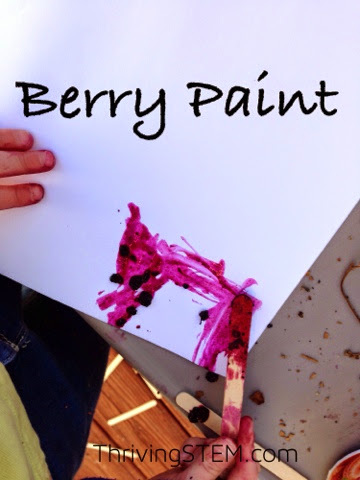
How to Paint with Berries

Don't you love art projects that use natural materials and produce a beautiful result?  Nature based art projects are a wonderful opportunity for kids to learn about  nature, practice the scientific method, and do some engineering all at the same time. Sometimes this is called STEAM, adding art to STEM. To be honest, my kids had to beg for this activity.  I was really nervous about the mess.  It was not that bad, though, especially since we worked in the back yard.

My kids loved this natural art project!! The science and engineering play are built in, for a great STEAM learning experience.

The berries we used were wild elderberries that had been growing in our backyard.  It turns out that elderberries can be used for medicine.  We decided to use ours for paint instead.  

CAUTION: If you think there is a possibility that your little artists will want to eat the paint, stick with a food edible berry like blue berries.  For our purposes, I just kept the littlest one occupied elsewhere.  Like many types of paint, ingesting this substance would be dangerous!  


My kids loved this natural art project!! The science and engineering play are built in, for a great STEAM learning experience.

Materials you will need for Painting with Berries

Berries
White paper
Sticks, pine needles or paint brushes
Plastic dish
Water
Baby wipes for clean up

The kids started by gathering some berries from this vine.  If you do not have wild berries in your yard, it would be worth purchasing a package for the sake of art and science.


My kids loved this natural art project!! The science and engineering play are built in, for a great STEAM learning experience.


This berry juice does not come off of hands easily with soap and water, but baby wipes took it off of everything!  

My kids loved this natural art project!! The science and engineering play are built in, for a great STEAM learning experience.

Once the berries were gathered, they used the stick to mash the berries. 

My kids loved this natural art project!! The science and engineering play are built in, for a great STEAM learning experience.

 They then added a little water, and more berries, and then mashed some more.  

My kids loved this natural art project!! The science and engineering play are built in, for a great STEAM learning experience.

Finally, it was time to paint!

My kids loved this natural art project!! The science and engineering play are built in, for a great STEAM learning experience.

My kids loved this natural art project!! The science and engineering play are built in, for a great STEAM learning experience.


The results were quite stunning.  The berry color was vibrant even after it had dried.  I think that we will be repeating this project.  I hope you will give it a try too!


If you enjoyed this post, consider signing up for the Thriving STEM newsletter to receive a summary of each month's activities with their corresponding objectives, and occasional coupon codes!

More Sensory Learning Ideas

Interested in a whole unit of  preschool senses learning ideas? Check out this unit that I coauthored with 11 other teacher/mom bloggers.  

Purchase 5 Sense Preschool Lesson Plans


Other posts you may enjoy:


Saturday, July 26, 2014

The Other Way to Make Balloons Float


"Hey Mom, Look!"  Have I mentioned that is my favorite phrase?  Well, at least when it means "Look what I noticed," not "Watch me break my leg."

These balloons were filled with plain old air, not helium.  However, they were floating up, and then falling down again in a kind of circular pattern.  It was really quite mesmerizing.  When I asked my children why this was happening, they quickly identified that the air particles from the vent were hitting the balloon and making it move.  This is great, because understanding that air is made of molecules that can have this impact is one way to prove that gas can have mass, and therefore really is matter.  Most people today readily believe this, but it is not actually all that intuitive, and has been highly debated in other times.

T-Rex was able to give me a clear explanation of the major forces.  Gravity pulls the balloons down, the air molecules push them up.  When the force of the air molecules is greater than gravity, the balloon moves up.  When the force of the air molecules is smaller than the force of gravity, the balloons move down.

In terms of energy, there is a transfer of kinetic (moving) energy from the air molecules to the balloon. As the balloon moves up it trades its kinetic energy for potential energy due to gravity.  When it falls toward earth again it trades the potential energy for kinetic energy once again.  

Next time you notice a moving object, stop and ask.  Why is it moving? It can be a pretty interesting question.


The purpose of this Science Along the Way series is to help me, my children, and my readers stop and notice the amazing physical world in which we live every day.  Thanks for reading!


Friday, July 18, 2014

Pivot Points and Spinning Spoons


Children are hard wired to do science.  T-Rex (5) and Pony Artist (4) demonstrated this the other day at breakfast.   I do not know who started it, but they took turns spinning this spoon.

Pivot Points and Spinning Spoons


Children are hard wired to do science.  T-Rex (5) and Pony Artist (4) demonstrated this the other day at breakfast.   I do not know who started it, but they took turns spinning this spoon.


They discovered that the spoon spins best when just one point touches the table.

  They tried placing the spoon with both ends touching the table. It did not spin well, and tended to flip over.  

It was a perfect experiment with just one variable: which way the spoon was facing. I pointed out to them what they had done, but they were more excited about the spinning spoon itself.


You see, they had just figured out an important physical principle.  Solid objects naturaly spin around a single point.  They might not put it into words just yet, but they definitely learned it. 


What have you and yours learned from play this week?