Showing posts with label Learning at Home. Show all posts

Monday, August 24, 2020

How to do a simple multisensory subtraction drill

 None of us want our child to struggle with math facts. We hope that skills like subtraction will come easily to them, or plan to drill at home to help give them an advantage in the classroom.


If your child doesn’t learn through traditional means, it can be disappointing, and a little scary.  You might scan the app store hoping to find a clever solution, or order some flash cards to drill with. What is really going to help them?


Friday, July 22, 2016

How to get a box of amazing hands-on science projects sent your door

"You haven't given your kids a chance to be bored!" My mom's assessment of our summer schedule reflects my own feelings, but I don't think my children would agree. No one wants the school schedule back, but they could handle a little excitement, and even some learning. The summer chaos has already doubled my work load in the kitchen and the laundry room. Planning great activities is tough. Can you relate? If so, I have the perfect solution for you today.


Do you ever wish someone would just put together four or five science projects, and box up everything you need and send it to your house?


Monday, June 27, 2016

How to learn chemistry while making delicious pickles

Mabel made dill pickles. Since it was bad luck to give away sour things, she demanded that we pay a penny for her goods. I imagine her recipes died with her. Miss Evie, our neighbor next door and Mabel's cousin, was a Pentecostal, and therefore not superstitious. She gave us her sweet pickles and the recipe freely. My dad gave her cucumbers and onions from our garden. 

Monday, June 6, 2016

How to stop the Summer Slide without destroying your child's summer

How do you help students stay sharp over the summer? Your student is sure to find something they enjoy on this great list of books.


The warm sun bounced down through the leaves of my favorite tree. I'd finished my morning's work, and was now free to enjoy the afternoon. I settled into the perfect smooth corner the branches made with the trunk, and opened the book I'd brought up with me.

I wasn't thinking of anything but enjoying the afternoon, but as a mother and a teacher I now know that by reading all those books I was accidentally preventing something called the Summer Slide. 


Wednesday, April 27, 2016

How to Protect Migrating Birds from Flying into Your Windows

On a lovely day in late spring, moms were chatting, and children playing when "THUD". The sickening sound of a bird hitting a window sounded through our home. The children rushed outside to help the poor creature, while the moms called to them not to touch the poor creature.


Birds can be harmed year when they fly into your windows.  This fun craft is an economical, and effective solution.


Thursday, November 19, 2015

Adding Doubles Christmas Tree Math Puzzle for Kindergarten


Adding Doubles Christmas Tree Math Puzzle for Kindergarten


As my first fall in the classroom drew to a close, it dawned on me that I wasn't going to make it through my curriculum.  With mandated exit tests looming (as in, fail the test, and you don't graduate), I knew I needed to at least get the planned content in front of my students.  I also knew that they expected to have a party the last day before Christmas break. In a move of desperation, I wrote an entire unit's worth of material into a Christmas theme and taught the whole thing the last day before break.  They moaned and groaned, but most of them decided to play along, and when we reviewed months later they remembered our reindeer games!


Friday, July 17, 2015

Kids in the Kitchen: Chicken 'n Science

Cooking is one of those hands-on activities that naturally employs all sorts of STEM  skills: science as you observe change, technology (especially if you are into gadgets like my husband!), engineering as you control change, and math as you measure and time.  Today, I am excited to join the Kids in the Kitchen Project hosted by Jennifer at Study at Home Mama.  I like to precook a whole chickens for future use, and my kids love helping me pick the meat. Here is how you can learn some great science while preparing your own chicken dinner!


Cook dinner and enjoy some great science exploration at the same time!

Wednesday, April 22, 2015

How to raise kids who care for the earth

Earth Day is drawing to a close.  In celebration, my son planted some grass at school.  I am sure there was more to the project, but he really loves seeds. The planting itself is what grabbed his attention.

 Earth Day is a good holiday, but like Thanksgiving, it reminds us of a habit that needs to be ingrained more deeply in our daily life.  How do you raise eco-conscious kids who really care for the earth?

.

We all know that it is important to care for our environment, but how do you raise kids who think the extra effort is worth it?

How do you raise kids who are passionate about ecology? You teach them to love the little creatures in your neighborhood. 

My children love to save earth worms after a rainstorm.  They don their boots and we head up the street to a place where we know that dozens are drowning.  

As they work, we discuss why the puddle is so dangerous to the little annelids.  We talk about how they make our community a better place.  We talk about native earthworms and invasive species from the bait shop. Their brains are sponges at that moment, soaking up the facts. 

We all know that it is important to care for our environment, but how do you raise kids who think the extra effort is worth it?


However, something even more important is happening. They are learning to love those little worms.  As they feel their live, wriggling bodies, and mourn the ones who didn't make it, they know there is something wondrous about each little life.  They feel how vulnerable the worms are, and they sense that they can make a difference.  

We all know how recycling works, but what prompts you to grab a piece of trash you didn't drop, or to conserve when it is so easy just to get a new one?  You have to care.  

We all know that it is important to care for our environment, but how do you raise kids who think the extra effort is worth it?


So, by all means, make crafts from your trash and plant seeds.  But, if you really want to help your kids love nature, go out and find the little animals living in your neighborhood, and see if there is something you can do for them.


P.S.  After I published this post, I came across a similar post from Mae at Mommy Loves Trees, that includes some research and a few more ideas about helping kids love nature.  Check out 3 Totally Crazy Ways to Spend Earth Day.


Be the first to know about new curriculum from Thriving STEM and receive an organized list of new and seasonal ideas for enjoying science and math with your children by signing up for the Thriving STEM newsletter.


More ideas for inspiring kids to love nature


I spy rot!: Effortless science lesson


Friday, April 10, 2015

Bottle Toss: Fun and the Physics of Flight


Today, I have another junk play post to share.  T-Rex invented this game and both he and his sister really enjoyed it. If you have elementary kids, this would be a great activity to pull out for some after school fun.  You'll be sneaking some great physics too!


My children loved relaxing after school with this simple, active game. And they were learning so many things at the same time!


Materials for "bottle throw"


Conditioner bottle
String (We used our clothesline)
Water (Optional)

The goal of the game is to catch the bottle and then throw it back over the line, in the yard, without your opponent catching the bottle.

This is a nice demonstration of standard projectile motion.  However, you also get the added complexity of a rotating object instead of a point.


My children loved relaxing after school with this simple, active game. And they were learning so many things at the same time!


The Pony Artist added a variation which includes a second bottle.  The goal is to hit your opponent's bottle and knock it back onto their side of the string.

This is a beautiful momentum and collision demonstration.

My children loved relaxing after school with this simple, active game. And they were learning so many things at the same time!

Finally, I suggested adding some water to the bottle.  I asked what difference they observed. They noticed that the bottle did not go as high.  Equal force with greater mass results in less acceleration.

Bottle Toss: Fun and the Physics of Flight

I did not spend much time discussing physics with my kids.  In fact, it would have been just as well if I had not discussed any at all.  They were learning just the same.  These experiences of basic play where children experience how the world works first hand are incredibly valuable.  They are building the background knowledge that they will pull from as they study science formally in the years to come.  

 An occupational therapist would have her own list of reasons that this play is useful.  Active, hands on play is extremely valuable.  The best news is, all you need are simple objects, some of which you were going to discard anyway.

For more great ideas on how to use your junk for play, check out the Junk Play Challenge hosted by Best Toys 4 Toddlers.


Be the first to know about new curriculum from Thriving STEM and receive an organized list of new and seasonal ideas for enjoying science and math with your children by signing up for the Thriving STEM newsletter.


Other Posts You might Like:


Toy Car Physics Unit


Thursday, February 12, 2015

Messy Fort: A Simple Strategy for Making Any Day Special

Building a fort is great engineering practice that helps kids learn physics and  develop their creativity. When I saw the Fort a Building Challenge from Building Blocks and Acorns I knew it was a project for us. However, it did not go as expected.  

After a fun day, that ended up having nothing to do with forts, some illness, and some general disruption of this mother's plans, I finally resorted to just making the fort myself on a random day. After all, setting the example is one of the most important aspects of involving kids in STEM, right?

Here is a fun way to make an ordinary day special.  Check out this DIY fort where kids can do art, eat, and even do their home work.


Materials for this Messy Fort


Foam Mats
Tarp
Dining Room Chairs
Sheet
Twisty Ties

How to Set Up a Messy Fort


I chose this spot in our dining area, because I wanted natural light pouring into our fort so that it would be good for art.  We had already lined the windows with painters tape.


Here is a fun way to make an ordinary day special. Check out this DIY fort where kids can do art, eat, even do their home work.

I put down the foam mats to protect the floor and make a comfortable place to sit .

Here is a fun way to make an ordinary day special. Check out this DIY fort where kids can do art, eat, even do their home work.

The mats were covered with a tarp for added protection.  I wanted to be sure the kids really had the chance to get messy!

Next, I arranged four chairs on the edge of the tarp.

Here is a fun way to make an ordinary day special. Check out this DIY fort where kids can do art, eat, even do their home work.

Finally, I topped it all with a bed sheet, and fastened the corners with twisty ties.

Here is a fun way to make an ordinary day special. Check out this DIY fort where kids can do art, eat, even do their home work.

How We Enjoyed our Messy Fort


My preschooler was the first one to use the messy fort .  She loved being able to play with play dough on the ground.  I do not normally allow that.  She made some shape patterns and did an experiment by mixing two types of play dough.


Here is a fun way to make an ordinary day special. Check out this DIY fort where kids can do art, eat, even do their home work.

Next, I set up a special sensory play for my toddler.  I mixed up some bubbles with the dish soap, and put them in a pot.

Here is a fun way to make an ordinary day special. Check out this DIY fort where kids can do art, eat, even do their home work.

She enjoyed exploring and squishing the suds between her fingers. Sensory play is science for babies!

Here is a fun way to make an ordinary day special. Check out this DIY fort where kids can do art, eat, even do their home work.

When my oldest got home from school, he was excited to get on on the action.  He ate his snack in the fort, then he used water colors to practice his spelling words and do some art.

Here is a fun way to make an ordinary day special. Check out this DIY fort where kids can do art, eat, even do their home work.

Some times, rather than adding a new activity, we just need to liven up the ordinary tasks. My children loved that they had a special place to enjoy their normal activities.  We enjoyed our messy fort, and I am looking forward to many more forts to come.

How do you like to liven up ordinary days?


There have been some great forts done as part of this fort building challenge including, an ocean fort, an outdoor fort, and a space fort.  All great science themes!  It is not too late to get in on the fun.  Check out the Fort Building Challenge homepage, build your own fort, and even send in a picture.


You May Also Enjoy:

The Surprising Truth About Why Your Child Makes So Many Messes


I Spy: Rot! An Effortless Science Lesson


Friday, February 6, 2015

Easy Kids Toy Valentine

Make a simple toy Valentine with or for your kids.


Here's a simple do it your self Valentine that doubles as a toy

I used to spend hours in my mom's bedroom playing with two tiny toy dogs that she kept in her dresser. The dogs were Christmas presents from her brother on a year when there hadn't been much in her own girl hood. The toy dogs used to mysteriously float toward each other, joining with a "clink!" They would pull each outer around from opposite sides of a piece of paper. They were amazing!


Friday, January 23, 2015

How to Use Paper Snow Flakes to Learn Math

Paper snow flakes are a classic project that kids love. They're also a great way to learn a little math.

how to use paper snow flakes to learn math

On a bright January day, perfect to look at, but too cold to stay outside for long, I needed something to do with my bright energetic children.Paper snow flakes were one of my favorite crafts as a child, and I thought that just maybe they would enjoy making some as well.
To introduce this activity to my kids, I folded the paper in half just once and cut two shapes, I got two shapes.Then, I folded to the paper in half twice and two cut shapes.We found four when we unfolded the paper. I continued adding more and more folds, cutting two shapes each time, and they were excited to see that there were more and more shapes.

Making paper snow flakes is a classic winter activity that kids love.  Did you know it teaches math too?
Multiplying by 2, again and again.

 I asked my children they could find the pattern, and they said "no", but they were grabbing for the paper and the scissors to make their own!


Making paper snow flakes is a classic winter activity that kids love.  Did you know it teaches math too?
They were grabbing for the paper and scissors


 How to make your basic paper snowflakes 


 If you would like to try this activity, you will just need a stack of tissue paper cut into squares and a pair of scissors.

Making paper snow flakes is a classic winter activity that kids love.  Did you know it teaches math too?
All you need!


Fold the paper into triangles. You can fold as many times as you like as long as you keep the same center point.

Making paper snow flakes is a classic winter activity that kids love.  Did you know it teaches math too?
Mark the center carefully


Cut patterns into the sides of the triangles, then unfold the tissue to see your finished product!


Making paper snow flakes is a classic winter activity that kids love.  Did you know it teaches math too?
Opening the snowflake!


 How to demonstrate the math in snowflakes 


 Real snow flakes have six sides. To get this effect, fold the initial square in half to make a triangle,
then fold that triangle into thirds


Making paper snow flakes is a classic winter activity that kids love.  Did you know it teaches math too?
Real snow flakes have six sides.
.


You could say that this snowflake demonstrates f = (n/2)(xy) where n is the number of cut outs, and x and y represent the number of sections the paper was folded into.  x = 2 when it was folded in half.  y = 3 when it was folded in thirds.  The total number of shapes is f = (2/2) (2*3), which is 6.  

Making paper snow flakes is a classic winter activity that kids love.  Did you know it teaches math too?
 Six shapes in the snowflake


This pattern corresponds to f= x^y where x is the number of shapes cut, and y is the number of folds.

For elementary students, I recommend that you do just what I did.Show them the pattern, encourage them to guess what it might be, then let them enjoy the project.If you are working with older students you might assign making snowflakes that follow a certain function, or you could let them make some snowflakes, and translate them into math.

Making paper snow flakes is a classic winter activity that kids love.  Did you know it teaches math too?
.

The wonderful thing is that they are automatically doing math to figure out how to get the designs they want.  Add in the added brain connections from doing hands on learning, and you have a great STEAM project that they'll be excited to share with their own kids one day.


Beaded snowflakes

More Math Crafts

Beautiful multiplication pine cone craft
Chaos theory for kids


Find out about seasonal projects each month! 


Each month I send an e-mail with seasonal projects like this one to my subscribers. Sign up now to receive next month's newsletter.

More Indoor Activities for Older Kids 


Today, I am excited to be joining a project hosted by Erica at What We Do All Day.  She is a true professional mom, and I love reading her blog to get ideas for my own kids.  Several fantastic blogs are joining in today to bring you indoor activities that you can do with your older kids.  If you are like us, and never know when you will be stuck indoors due to bad weather, you will want to be sure to pin these ideas for later!
Indoor Activities for Tweens come from What We Do All Day

Working With Yarn - 10 Ways to Create come from Betsy's Photography

  Wooden Bangles for Animal Lovers from Adventure in a Box

Inside Activities Promoting Growth Mindset from Planet Smarty Pants

Indoor Pom Pom Races from Lemon Lime Adventures 

Simple Duck Tape Bracelets from the Gingerbread House

Making paper snow flakes is a classic winter activity that kids love.  Did you know it teaches math too?

Monday, January 12, 2015

I Spy: Electric Hair!

Winter time hat hair can be annoying or amusing.  In the case of my littlest one, it is downright cute.  I really tried to get you a picture that at least included her happy eyes, but she is a moving target when it comes to photography, and she really wanted Mommy's phone!

We have been repeatedly amused by this electrostatic result of wearing winter hats.


What we saw:


Little Diddle's hair is standing on end and the pieces are separating from each other.  This usually happens when she's been wearing her hat for a while, outside.

What we wonder:


Why do certain hats seem to bring about this result more than others?  Is there more going on than just simple electrostatics?


What Science do you Spy?


Other Posts you may enjoy:
Doing inquiry science after school, just for fun.
I Spy: An Echo Chamber


Have you ever stopped to notice the light coming through a tiny opening? Here's a fun introduction to diffraction.
I Spy: A Little Stream of Light


Friday, January 9, 2015

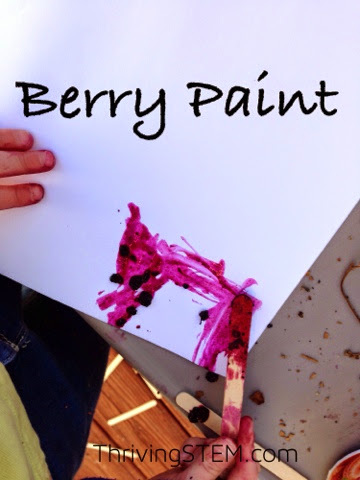
How to Paint with Berries

Don't you love art projects that use natural materials and produce a beautiful result?  Nature based art projects are a wonderful opportunity for kids to learn about  nature, practice the scientific method, and do some engineering all at the same time. Sometimes this is called STEAM, adding art to STEM. To be honest, my kids had to beg for this activity.  I was really nervous about the mess.  It was not that bad, though, especially since we worked in the back yard.

My kids loved this natural art project!! The science and engineering play are built in, for a great STEAM learning experience.

The berries we used were wild elderberries that had been growing in our backyard.  It turns out that elderberries can be used for medicine.  We decided to use ours for paint instead.  

CAUTION: If you think there is a possibility that your little artists will want to eat the paint, stick with a food edible berry like blue berries.  For our purposes, I just kept the littlest one occupied elsewhere.  Like many types of paint, ingesting this substance would be dangerous!  


My kids loved this natural art project!! The science and engineering play are built in, for a great STEAM learning experience.

Materials you will need for Painting with Berries

Berries
White paper
Sticks, pine needles or paint brushes
Plastic dish
Water
Baby wipes for clean up

The kids started by gathering some berries from this vine.  If you do not have wild berries in your yard, it would be worth purchasing a package for the sake of art and science.


My kids loved this natural art project!! The science and engineering play are built in, for a great STEAM learning experience.


This berry juice does not come off of hands easily with soap and water, but baby wipes took it off of everything!  

My kids loved this natural art project!! The science and engineering play are built in, for a great STEAM learning experience.

Once the berries were gathered, they used the stick to mash the berries. 

My kids loved this natural art project!! The science and engineering play are built in, for a great STEAM learning experience.

 They then added a little water, and more berries, and then mashed some more.  

My kids loved this natural art project!! The science and engineering play are built in, for a great STEAM learning experience.

Finally, it was time to paint!

My kids loved this natural art project!! The science and engineering play are built in, for a great STEAM learning experience.

My kids loved this natural art project!! The science and engineering play are built in, for a great STEAM learning experience.


The results were quite stunning.  The berry color was vibrant even after it had dried.  I think that we will be repeating this project.  I hope you will give it a try too!


If you enjoyed this post, consider signing up for the Thriving STEM newsletter to receive a summary of each month's activities with their corresponding objectives, and occasional coupon codes!

More Sensory Learning Ideas

Interested in a whole unit of  preschool senses learning ideas? Check out this unit that I coauthored with 11 other teacher/mom bloggers.  

Purchase 5 Sense Preschool Lesson Plans


Other posts you may enjoy: